Wolf Oven Repair
Wolf oven thermostat replacement: rule out these settings first
A Wolf oven thermostat replacement usually means testing and swapping the cavity temperature sensor, or recalibrating it, typically $190–$480 after diagnosis. First rule out the modes, locks and menu options that make a sound oven look faulty.
Written by Dallas McGivern Cooking-appliance technician — griddles and charbroilers · 10 years in the trade
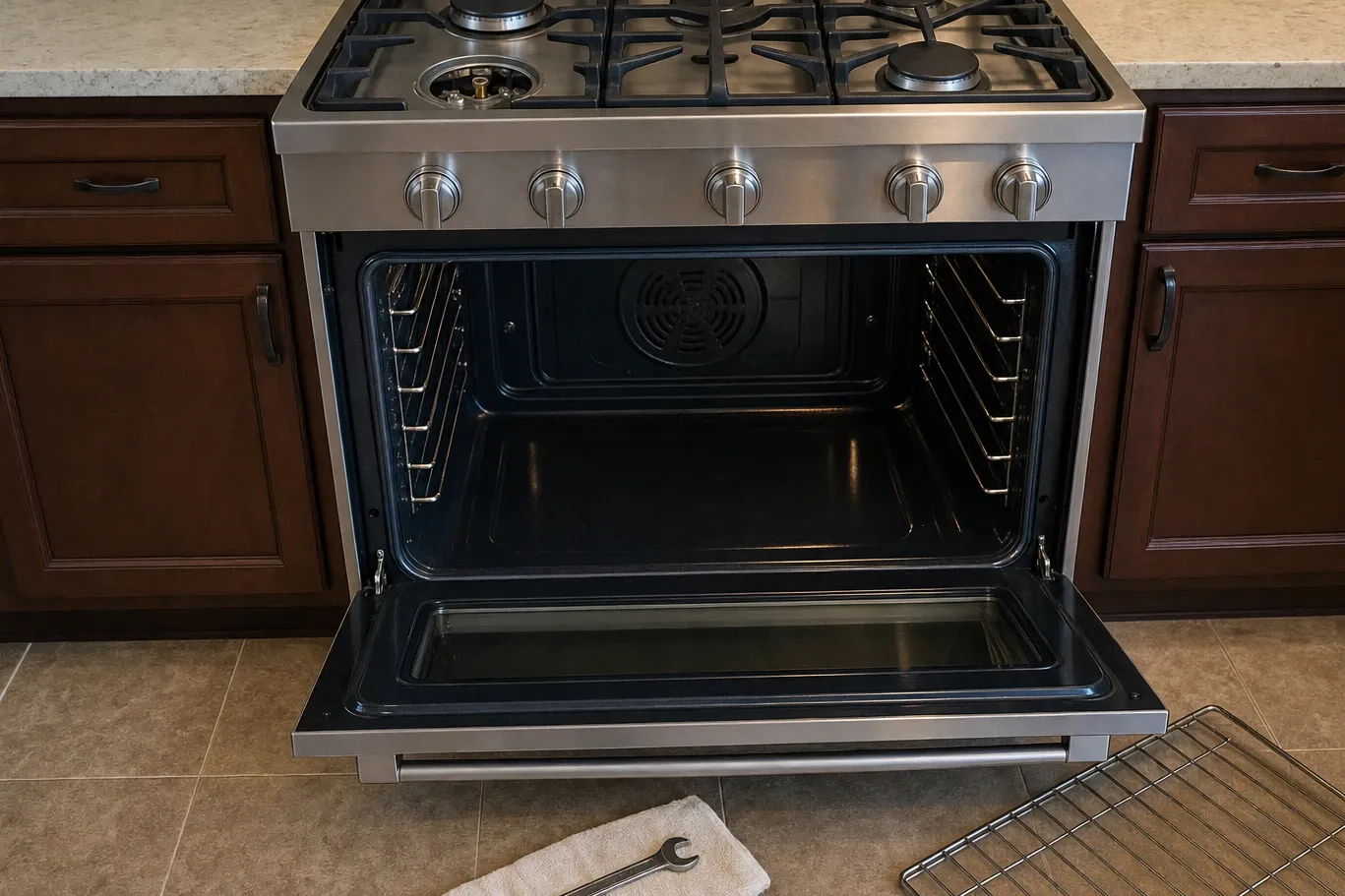
On nearly every current Wolf wall oven and dual-fuel range there is no separate thermostat to unbolt. The control board decides when to heat by reading a slim temperature sensor that pokes into the back of the oven cavity, so a thermostat replacement really means measuring that sensor, fitting a new one if it has failed or wandered, and confirming the oven then holds the number on the display. In Phoenix that work typically runs $190–$480, with the firm price given after diagnosis. Before paying for it, spend ten minutes on the settings below, because several of them produce symptoms that look exactly like a dead or drifting sensor.
What the word thermostat covers on a Wolf
Older knob-controlled gas ovens across the industry often relied on a bulb-and-capillary thermostat: a liquid-filled bulb in the cavity pushed on a valve as it warmed up. Electronic Wolf ovens swapped that for a sensor whose resistance rises as the cavity heats, and the board turns that reading into a temperature. Two things follow from this. The sensor itself is a modest part, so most of the cost sits in the visit and the testing. And because the board does the interpreting, a bad reading can come from the sensor, its wiring harness, a loose connector behind the oven, or the board. Replacing the sensor without measuring it first is a guess.
If the oven runs hot or cold by a steady amount rather than refusing to heat, our guide on reading temperature drift in a Wolf oven walks through the oven-thermometer test step by step.
Settings that pass for a bad sensor
Temp Offset and Calibration are different tools
Open Settings on a Wolf M Series oven and you will see two options with similar names. Calibration there adjusts the touchscreen, so the screen registers taps where your finger lands; it has nothing to do with heat. Temp Offset is the option that shifts oven temperature, and Wolf marks it for service use only. Wolf adds that calibration is possible but seldom necessary, is never an owner task, and applies to every cooking mode at once. If a previous owner or an earlier technician changed the offset, say so when you book, because an old adjustment stacked on a new sensor can push the oven off in the opposite direction.
Sabbath mode
Sabbath on an M Series oven limits you to Bake, Roast, Proof and Warm, and the oven slips into that state ten seconds after you press Start. Change the temperature while it is active and the new setting takes hold at a random moment rather than straight away. If someone used Sabbath over a holiday and the oven later seems to ignore a new temperature, this is the likely reason, not the sensor.
Timers never switch the oven off
Timer 1 and Timer 2 on an M Series oven each go up to 11 hours and 59 minutes, and E Series timers stretch to 99 hours and 59 minutes. Neither kind touches cook time or stop time. A countdown reaching zero will not cut the heat, so a roast that kept going after the beep points to how the timer was used, not to a control fault.
When the oven will not heat at all
A cold oven with a lit display is seldom the sensor, which tends to cause wrong temperatures rather than none. Check these first:
- Control lock. On an E Series oven, touching and holding Lock for three seconds locks or unlocks the panel and touchscreen. The lock has to be reset after the power goes out, and the summer monsoon storms that sweep across Phoenix are a common cause of short outages.
- The 12-hour shutoff. An E Series oven turns itself off after 12 hours of continuous running, unless it is in Dehydration or Sabbath. Wolf’s own troubleshooting lists this as a reason the oven stops operating.
- Showroom mode on a speed oven. Demonstration mode lets the buttons and screen respond while no power reaches the heating parts. To leave it, touch Settings five times, touch 6, then Start until DEMO OFF appears.
- Half a breaker. Electric ovens run on a 240-volt circuit, and losing one leg of that supply can leave the display glowing while the elements stay cold. Check both halves of the double breaker.
Preheating, and the smell of a new oven
Wolf ovens sound a tone when they reach the set temperature. To preheat, pick the mode, enter the temperature, press Start and wait for that signal. On an M Series oven the sound level can be set anywhere from mute to high, alongside display brightness from 0-100%, so a muted oven finishes preheating in silence and can seem as if it never got there. Turn the sound back up before you blame the sensor.
A brand-new oven brings a different false alarm. Wolf asks owners to clean the cavity first and then run a burn-off. For an M Series oven, Wolf calls for a full hour of Convection Roast set to 500°F (260°C), with the hood fan on or a window open. On a Wolf all-gas range it is Bake at 500°F (260°C) for 30 minutes, Broil for another 30, then cooling with the door closed. Some smoke and odor during that run is expected and does not mean a part is failing.
Resetting before you book
For most Wolf ovens a reset simply means switching the breaker off for a minute or two, turning it back on, and then setting the clock and any lock again. The speed oven also has a menu route: touch Settings four times, then Start, and FACTORY SETTINGS RESTORED appears on the display. A reset clears confused controls; it will not revive a sensor that has gone open or reads wrong.
When the sensor really has failed
If the settings are clean and an oven thermometer on the middle rack disagrees with the display by a wide or shifting margin, or the oven shows a sensor fault, it is time for a technician. The first step is the $89 call-out, which pays for the technician’s time at your door plus all of the testing, and it is credited in full against whatever repair you sign off on. The technician measures the sensor cold and warm, inspects the harness and connector, and checks what the board is reading before quoting. Sensor replacement or calibration typically falls between $190–$480. If the board is the culprit, that becomes a separate job, typically $420–$860.
We work on Wolf ovens in Maryvale, Roosevelt Row, Coronado and Sunnyslope. The Wolf oven repair page lists what we handle, or call (602) 223-1020 to set up a visit.
Follow-ups
- How do I reset a Wolf oven?
- Switch the oven's breaker off for a minute or two, then back on, and set the clock and any panel lock again. Speed oven owners get a second route: press Settings four times in a row, then Start, and wait for FACTORY SETTINGS RESTORED on the screen. A reset clears control glitches, but it cannot bring back a failed sensor or element.
- Does a Wolf oven beep once preheat is done?
- Yes, the oven sounds a tone once it reaches the temperature you set. If you never hear it, check that the sound level has not been turned down to mute in Settings. For bread and pastry, give it roughly ten more minutes after the tone, because the walls and racks warm more slowly than the air.
- Why will my Wolf oven door not close properly?
- A door that will not sit flush usually has a worn or bent hinge, a seal that has slipped out of its channel, or a rack edge catching the inner glass. Do not force it, since a gap leaks heat and throws off temperature readings. Hinge, glass or seal work typically runs $300–$670, with a firm price after diagnosis.
- Can I change the temperature offset on my Wolf oven myself?
- No, Wolf reserves the Temp Offset option for service use and says calibration is rarely needed. The Calibration entry owners can reach in the M Series Settings menu adjusts the touchscreen, not the heat. Because an offset moves every cooking mode at once, mention any earlier adjustment to the technician who visits.
- Is a sensor repair worth it on an older Wolf range?
- Usually, yes. A sensor or calibration job typically costs $190–$480 after diagnosis, a small fraction of what a comparable professional range costs new. Unless the range also needs a control board, burner valves and door work at the same time, fixing the temperature circuit is the sensible first move.